Tuesday, November 26, 2013

Bad Start, Great Finish!


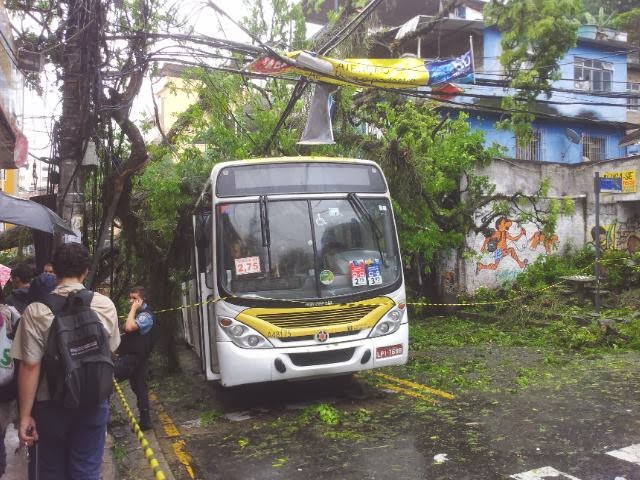
The first two fotos you see were taken from my cel phone inside the bus just minutes after the tree fell. I stuck my arm out the window of the bus, pointed and tried to get the best foto that I could of the fallen tree. The first foto you can see the huge green thing that covers the whole foto is the big tree. The second foto is people running to make sure nobody is injured. The last two fotos were taken by one of our guides, Jody King as he was heading up the hill around 11am.


Where was Rambo when we needed him? (Rambo is a tree trimmer who lives and works in the favela)


I left my house this morning feeling upset because the weather was crappy, drizzling rain.. I had already cancelled our planned BBQ for our special tour for our Danish visitors. The day wasn't starting off so good. I got onto the bus to go to Copacabana at 9:15am, plenty of time to arrive to my destination. As we are driving up towards the painted houses in the favela, we stop close to the entrance to Rua 3 when all of a sudden I hear this cracking sound, like tree branches breaking. All of a sudden a big thud and just behind us about 5 meters. I see a tree down on top of the bus directly behind us. After that, you could hear power lines dropping and electricity power boxes exploding and all sorts of popping sounds. The driver of my bus opens all the doors and people are running frantically out and screaming about the loud noises they are hearing. They are running up the hill away from the tree and noises scared! Because its my job to notice everything (I am a tour guide), I knew I was safe inside the bus. The tree dropped behind us with plenty of space open and there were no power lines close to the bus. That's when I decided to snap a few fotos with my cel phone. I know they are not the best quality but I was a bit far away and my positioning of having to stick my arm out the bus window was not easy. I see that after 5 minutes the bus is not moving so I tell the driver that its best that we move just incase more wires fall down. Actually I wanted him to move because I had guests to meet at 10:30am in Copacabana. We finally started moving after 15 minutes of sitting there. As the bus was leaving the favela, I started to think of how lucky I was to be on this bus and not the one directly behind me that got hit with the tree. I was sitting towards the back of the bus and if our bus had passed just 20 seconds later than it did, our bus would have gotten hit. As we entered Leblon, thick traffic and I am starting to worry because I do not like being late to appointments.


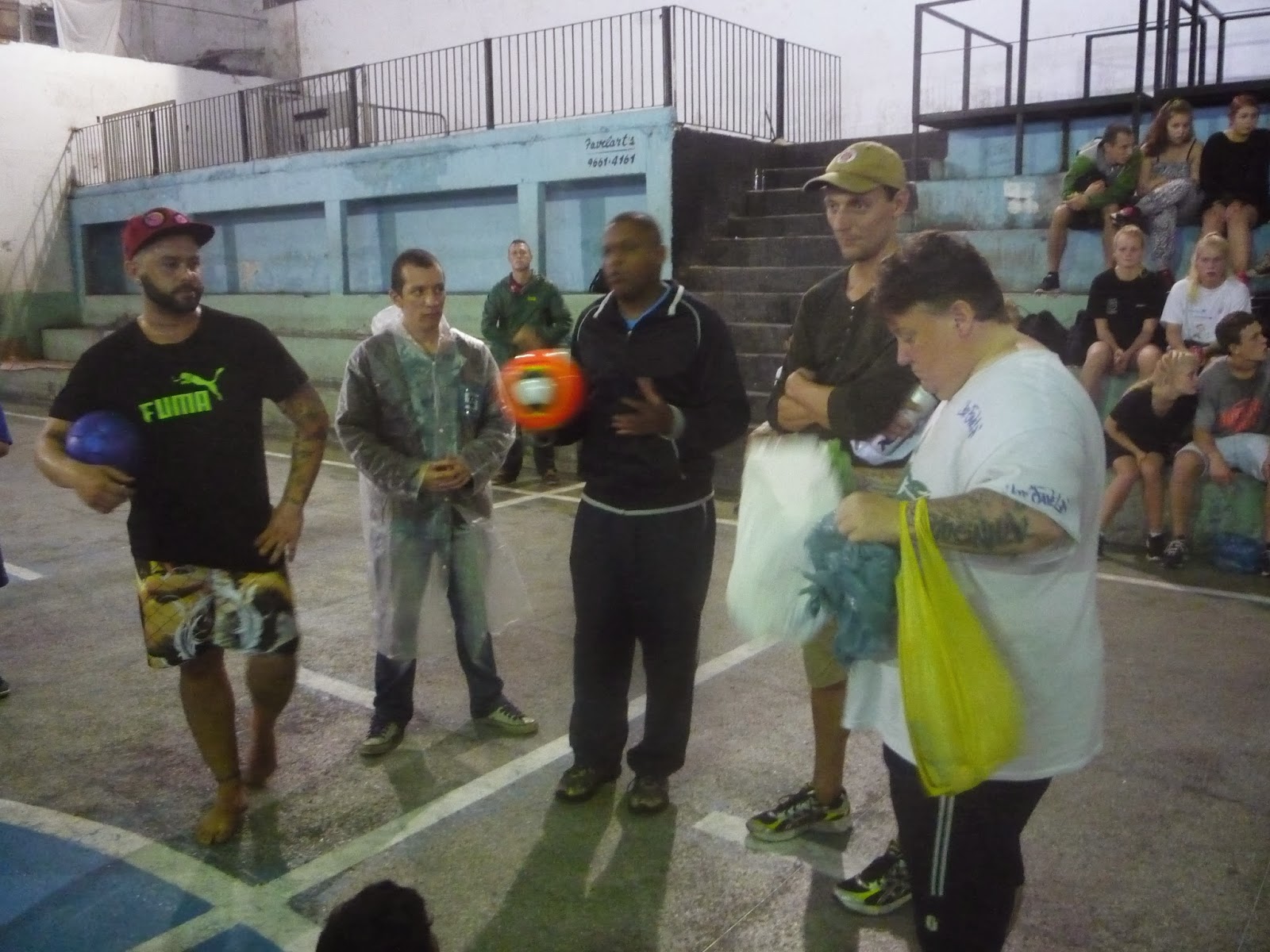
I finally arrive at my destination 20 minutes late! I meet my guests of 30 Danish students between the ages of 15-17 and 4 teachers. We walk to the bus stop to head back to Rocinha. We wait about 10 minutes and our group of 30+ people board the bus. I think the driver was surprised at the numbers of foreigners invading his bus! I sat down, took a deep breath and just started to think of the day ahead. We arrived at the top of the hill in Rocinha and directly took the students to the indoor football area. I met with Andre the local football coach and Dembore and I started to organize teams. Out of the 30 Danish, about 20 took part in the friendly game with the locals. We played 4 on 4 with a goalie (5 a side total). Nobody was keeping score as this was just a friendly game of mixed teams. Everybody played together mixing the Danish students in with the favela kids. This was great to see the passing and goal scored with team work!


After the friendly was over, we called the kids into a circle in the middle of the playing area and Rasmus Schack, the person who organized this special tour gave out some gift bags to 10 of the players. One of the Danish teachers gave Andre a cap and water bottle of the team in Denmark.


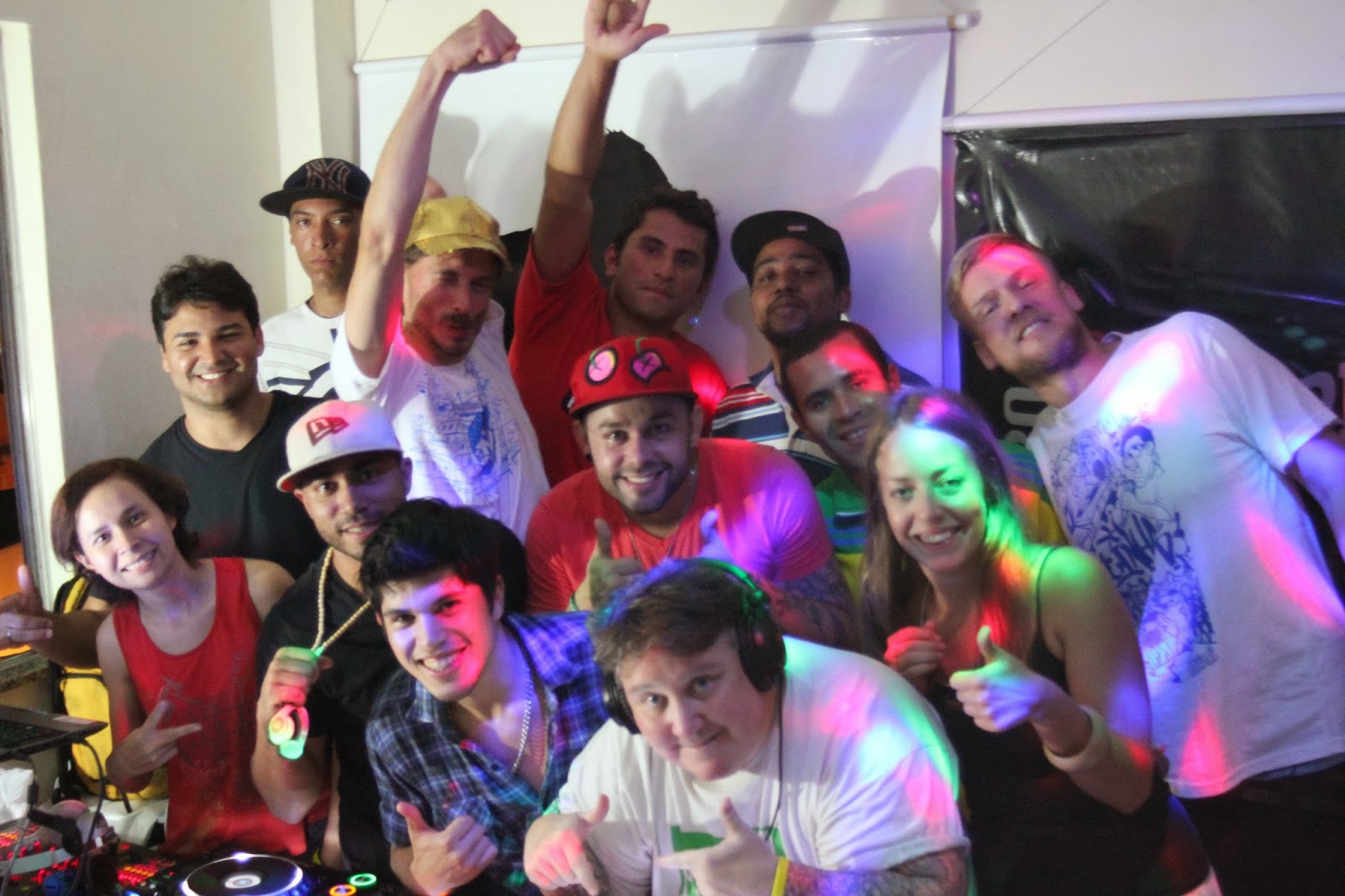
We all gathered for a foto with everybody who was involved in this game. The students and players sat together as it should be. I know the kids from the favela will remember this for a long time.


Before we left the football game, Andre wanted a foto with the guides! So from Left to Right, JODY KING, DEMBORE DA SILVA, ANDRE THE COACH, FREDDY GOMES, ZEZINHO DA SILVA AND ERIK MARTINS


After football we separated the students and teachers into smaller groups so we wouldn't look like a mass mob moving through the favela. We agreed to meet at the bottom of the favela at Trapia Social one of our best por kilo restaurants. After we took everybody up on the pasarella for foto and to say our goodbyes before they had to leave!


I need to thank RASMUS SCHACK for organizing this great opportunity and the teachers from Denmark for trusting in us here at Favela Adventures to show the Danish people our favela.


Before we separated ways, the guides, wanted a foto together..Freddy, Dembore and Jody!


After the tour I went back up the hill to see how things were going with the electricity and tree that fell. I spoke with some people at the site and they said the tree that fell was 60 years old. Nobody was injured. They were still removing the tree and trimming others in the area to prevent this from happening again. Electricity is down in the area and not expected to return for a few days as they have many power lines to fix. There's never a boring day in the favela..here are some fotos from the clean up. Notice the size of the tree that fell.


Friday, November 22, 2013

Why English?


My friends in Rocinha have asked me why I write the blog in English. I tell them that if I write it in Portugues only people in Rocinha would read it and I am trying to reach more people with the blog. People in Rocinha know how I feel about this place! I am trying to send a message out to the whole world about the place I live. And people in Rocinha already know about life inside a favela. I don’t want to bore them!

My blog covers all sorts of subjects as I write about life here in Rocinha but have different eyes because I had the opportunity to live outside of Brazil. My understanding and appreciation for Rocinha is much different now than when I was younger. I am thankful and proud to live here. I have no shame to say that I live in a favela or that I am a favelado.

We in Rocinha understand the class system and that people outside of favelas don’t really have interest to want to read about them. It is sad but this is the truth. Sometimes I think that these people wish that the favelas just disappear. Brazilians who don’t live in favelas, out of ten people, eight despise the favelas and see them as factories of criminals. Most of these people have probably never been inside a favela. But, their domestic help probably lives in a favela. I have met very few people who live outside of Rocinha that have an interest in the place. It doesn’t help that media like “O Globo” rarely write anything good about favelas.

The majority of people who read my blog are foreigners. People usually find my blog through searching google. I receive many emails from students, researchers, journalists and film makers who read my blog as a resource. They contact me and often times they want to meet personally to discuss their work. I then try to connect them with the right people who can help them.

Through my blog, I want to show the world my life here in Rocinha. The only way I can do this is through writing in English. I can reach more people with my message. For those who are interested in learning about favelas, my blog can give you an inside view that you cannot get in mainstream media. As I have told many people, there is no such thing as a bad place, only bad people, and every place has bad people!

I enjoy hearing from you. If you have any ideas on subjects for me to write about please contact me at: visitrocinha@gmail.com

Friday, November 15, 2013

Questions from a teacher in New Jersey, USA


The last four Photos in the sequence were taken by Miranda Patrucic


How does poverty in the favelas affect you or your neighborhood?--- Poverty is relative depending on where you live on the planet. Nobody in my favela is starving or dying. People struggle and have it tough because of lack of opportunities and institutionalized stigmas against favela residents. People from favelas often lie and don't tell where they live for fear of discrimination. This is sad because what do we teach our children when we lie. We teach them that there is shame because of the place we live. Favelas were hand built by the residents from those communities. We don't wait for government to help us. We do what we can with what we have. All we ask is to have the same rights and opportunities that any Brazilian citizen has!


Do you think the situation is getting better or worse?--- The police are here but no real improvement of public services. We still have the trash dumps that spill into the streets. You would think that if the country can spend 30 billion on sports stadiums for the world cup that they should be able to help with basic sanitation. We still have open sewers that run through parts of the favela. We need more schools with decent quality for our children and we need trade schools to teach young adults and provide opportunities to get into the workforce and earn good wages. How can somebody who earns minimum wage of 600 reais a month ever move out of a favela? You can not at that wage! We need more education and less guns (police)! (See the last four fotos which show the garbage and open sewers in the favela)


How would better security help you and your family?--- Security is relative. I have never felt fear living here. There are at times dangerous situations but I have never really felt scared. I have more fear outside the favela. Inside here we have rules. You break the rules, you pay, depending on the crime like rape or killing someone, you can die. The problem is we live in a country with a lot of corruption and where the life of a favelado does not have value the same as those who don't live in favelas. My ideal security would be a fair, respectful and honest police to every citizen. Most favelados are honest hard working people who just earn less money. We live here because there is no other option for us.


Have you ever thought about moving?--- No, My life is here, my friends are here. If I move, where do I go? I then need to start again to build a foundation of associates and friends. Even if I move, I will always be a favelado. Will the outside world accept me? I don't know. I love living here for the good things. The good things outweigh the bad. Its not the poorly built houses here, its the people who live here who make Rocinha a good place to live. In Rocinha we have everything, why would I want to leave?


What daily struggles do you think people in the favelas face?--- The first is quality education for children and youth. With education comes knowledge to help change or improve your living situation. Basic sanitation is a big one, nobody likes to pass the garbage dumps and see rats running around. Sometimes we go without water. Where I live I have a tank on my roof of 1000 liters that is refilled once a week. Sometimes, it doesn't get filled which means we go without until it gets filled. This past July, I went without water in my house for 15 days! The biggest complaint I have is just being treated with respect. Outsiders (Brazilians) treat us like we are slaves, drug dealers or some kind of criminals. Every social class has its crimes.


Do you feel safe in your neighborhood? Would you like better security in Rio?--- I feel safe in Rocinha. I think tourist places need better security and places like Lapa need police that will reinforce the laws. In Lapa I always hear of tourists getting pickpocketed or robbed.


How do people in the favelas support their families?--- People work as bus drivers, construction workers, cashiers, restarants, hotels and any other service industry work where college or university is not needed.


How do you feel about having the World Cup in Brazil? Will it hurt or help Brazil?--- It will help the rich, tourists, FIFA, and the investors but other than watching it on tv, favelados will not benefit from the games.


What does the government (and President Rousseff) do about the favelas?--- They do very little. They will provide something like a fancy footbridge to cross the highway yet leave open sewers running through the favela. Somebody once on a online forum made the comment that it would be easy to get rid of the favelas if they dropped a bomb on them. When I read this, it made me sad that people have such evil in their hearts and yet these same people claim they believe in god! (I am a atheist by the way). Its difficult to say what will be the future of favelas. Its now 2013 and not a lot of progress has been made. Favelas are convenient for the outside world when they want their cheap slave like labor or they want their cocaine, otherwise, they prefer the favela and favelados out of sight. The rich woman will despise the favela yet the cleaning lady or baby sitter comes from there. We may have police here but we have more shootings now since the police occupation than before. Ironic eh?


How do people end up in favelas?--- The favelas started because of people migrating to different parts of the country looking for jobs. When they arrived in Rio, they could not afford the rents so they were forced to live in favelas. This has to do with value of work. When you earn between 600-900 a month, you cant afford to live anywhere else but the favela.


How do children in the favelas get education and medical help?--- We have a few schools but the quality is not good and even if you graduate with top grades you still need to take a difficult entrance exam to get into the free universities. We have three health clinics, they are ok for basic health care but if you need surgery of some kind you need to go outside the favela. Health care is free but not very good.


Where are the worst favelas?--- The poorest favelas are in the northeast of the country. In Rio the worst favelas are in the outskirts of the city the north zone or west zone.


Thursday, November 14, 2013

Danish Cultural Invasion


I have been very fortunate to meet some amazing people through the work I do. I never imagined my life would change so drastically for the better. Working as a guide here is one thing but having the Dj School Spin Rocinha has opened up opportunities to benefit many here.


I was first contacted about 6 months ago by Rasmus Schack. Rasmus lives in Rio and is part of many projects. He's a DJ, Tour Guide and part of bringing Danish Culture to Rio de Janeiro. Instituto Cultural Da Dinamarca was founded in 2009 to expose Brazilians to Danish culture through events including, music, art, shows, cinema and workshops. Rasmus is also part of DinĂ¢mica Dinamarquesa is the project under the umbrella of Instituto Cultural da Dinamarca and its Rasmus who promotes Jazz and Danish Electronic music in Brazil.


He first contacted me about wanting to know more information about Spin Rocinha and having some workshop exchanges with Danish Dj's and producers. At Spin Rocinha, we have hosted some top Dj's in Brazil and believe its is a honor to have foreign Dj's that can bring enrichment to our programs. So, when he told us about Asmund Boye Kverneland or Dj COPYFLEX come for a workshop, we said sure! Dj COPYFLEX has an interesting background as a Dj but also has his own band COPIA DOBLE SYSTEMA which plays a mix of electronic music with Latin Beats.


So, we had Dj COPYFLEX and Dj Rasmus give a 2 hours seminar at our school. We also celebrated our 2nd anniversary of our Dj school Spin Rocinha.


Please check out whats going on with Instituto Cultural Da Dinamarca on their website www.dinacultura.org


Rasmus is also a tour guide who specializes in walking city tours. His website is www.riourbanexploration.com


LULU ROUGE come to Rocinha


Lulu Rouge consist of Torsten "Buda" Jacobsen and Thomas(T.O.M)Bertelsen who have been working together as Dj's and producers now for over 20 years. They released their debut album "Bless You" in 2008 and are now one of the most respected producer teams in Northern Europe. Their music is a mix of techno and dubstep with a deep bass sound that makes the ground shake. They have produced more than 100 complilations including soundtracks for advertisements and movies.


When DJ'ing, the duo never play any tracks in their original form. They only play their own edits and bootleg mixes, custom made for their sets. And as a live act, the Lulu Rouge sound really comes to its right elements with their famous heavy bass sound flooding the room. Played with live instruments, guest musicians and space for improvisation.


They came to visit Spin Rocinha on November 6th to show our students some of their skills. They played a 25 minute set of their music and after fielded questions from the students.


I want to thank Rasmus Schack for his constant support of our Dj School Spin Rocinha and exposing our students to these amazing talents!

Thursday, October 17, 2013

Freddy Gomes Working for Favela Adventures


- Can you tell me your name, where you are from? My name is Freddy Gomes, I'm 31 years old, and I'm from Holland. I speak English, Dutch and Portuguese.


- Why did you come to Brasil? I first came to Brasil in 2004, because I had family studying here. They invited me over, and I fell in love with Rio de Janeiro. I came to Brasil this time to live a different life, than the life we live in Holland. I wanted to experience life in a very different place.


- When you first arrived where did you live? During my first visits to Rio when I had family here, I stayed in the neighborhood of Tijuca, in the north zone of the city.


- How did you first find out about favelas? It was during my first visit that I found out about them. Tijuca is a middle class neighborhood, with a lot of favelas close by, so I used to see them everywhere.


- Why did you decide to come and move into a favela (Rocinha)? After coming to Rio for three times, I wanted my fourth time to be different. And because I was so interested in favelas, for me this was the perfect time to experience life in a favela.


- Before moving here what did you know about favelas? I've been to favelas before, but only for the baile funk parties. But there I saw some of the things that happen in favelas. Because I wanted to know more, I started to watch more movies and documentaries, and reading about favelas.


- Since living here, have your impressions of favelas changed much? It has not, because before coming here I knew what to expect. I did learn here that there are differences between favelas, and even within a favela, in terms of 'poverty'.


-What are you doing here in Rocinha? I'm here working for Favela Adventures, learning the business. It's great to give tours, and show people a place I love so much. I'm also working on football projects here, trying to support them through my own NGO called Sonvela.


- What do you like about living in the favela? I like the fact that the people here are proud to be a part of this community, even though many people say a favela is a bad place. I also like the spirit of people here, most people here love life, and they show it!


- What don’t you like? I don't like the fact that the government uses favelas and favela related projects just for their own benefit. The UPP installation in my opinion seems like a big 'cover up', especially after the things I've seen here... The cable car running in the Compexo do Alemao looks great on the outside, but for the resident there are things that have way more priority, like basic sanitary and education.


- If you had a magic wand and could change anything, what would you change about the favela? I would change the way people on the outside see favelas, and I would give the people in favelas even more power to change their lives.


- Has your experience been worthwhile? Yes it has, for me living here is a dream come true. Living in Holland I used to wonder all the time how it would be to live here, be accepted and even loved here...


- What advice would you give someone who wanted to move/stay here? Do your research! Before coming here, check out the movies, watch the documentaries, watch the news and read about life in favelas. If you come prepared, you will have the time of your life!


- I understand that this is your second time coming to Rocinha. Why did you come back to live here again? It is! When I left here in march 2011, I knew I had to return. I left so many great people behind, there was no question I was coming back. People here treated me so good, that even during my absence I felt being part of the community!


- Anything else you would like to comment about regarding life here? Rocinha is a great place to live a life that is very different from what we know in Europe or the U.S. Come and visit, you won't regret is!!


Thursday, October 10, 2013

Interview with Andy Barros


- Can you tell me your name, where you are from? Andy Silva. I'm from San Francisco, and have lived in the US for pretty much all my life. Right now I live in Switzerland.

- Why did you come to Brasil? My father is originally from Brazil, and I wanted to learn more about how he grew up. I also wanted to learn a bit of Portuguese.

- When you arrived where did you live? I stayed in a small apartment available for volunteers at Two Brothers Foundation, owned by Seu Jose in Cachopa.

- How did you find out about favelas? I had heard tidbits about Brazil's favelas before, but most of what I learned about favelas was from talking with Zezinho.

- Why did you decide to move into a favela (Rocinha)? I wanted to do community work, and Rocinha is known for its abundance of community organizations. The one I picked, Two Brothers Foundation, was located in Rocinha, so I decided to move close by.

- Before moving here what did you know about favelas? I knew that they were poor, and known for their presence of drug gangs. I had heard that favelas could be very dangerous places.

- Since living here, have you impressions of favelas changed much? Yes. It's true that favelas are poor and have a large presence of drug gangs, but they're not as violent as the media (and sometimes other Brazilians) claim them to be. There is violence and drugs in the favelas, but if you play it cool and don't go looking for trouble you can stay relatively safe.

- What do you like about living in the favela? I like that the people are friendly and that they generally create a very close-knit community. I like the music and dances in the favelas, and the relaxed atmosphere.

- What don’t you like? I don't like the presence of alcohol, other drugs, and weapons. As innocent as alcohol may seem, the commercial areas of favelas like Rocinha are lined with bars. I also don't like the violence and abuse present in many families.

- If you had a magic wand and could change anything, what would you change about the favela? I think if I could provide on thing to the residents, it would be education. In what form, I do not know, but with education comes opportunity, which may grant the residents the freedom to change the favela in ways they see fit.

- Has your experience been worthwhile? Most definitely. I had a great experience living and working in Rocinha, and would recommend it to anyone.

- What advice would you give someone who wanted to move/stay here? Come to Rocinha, or any other favela, with an open mind. Be modest in the presence of cultures foreign to you. Understand that if you come from a wealthier country, that Brazilians may hold many stereotypes of your culture, as you may hold of theirs. Don't reinforce their stereotypes, and don't allow them to reinforce yours.

- Would you come back to live here again? Yes! Particularly if I had a great community project to work on.

Thank you Andy!